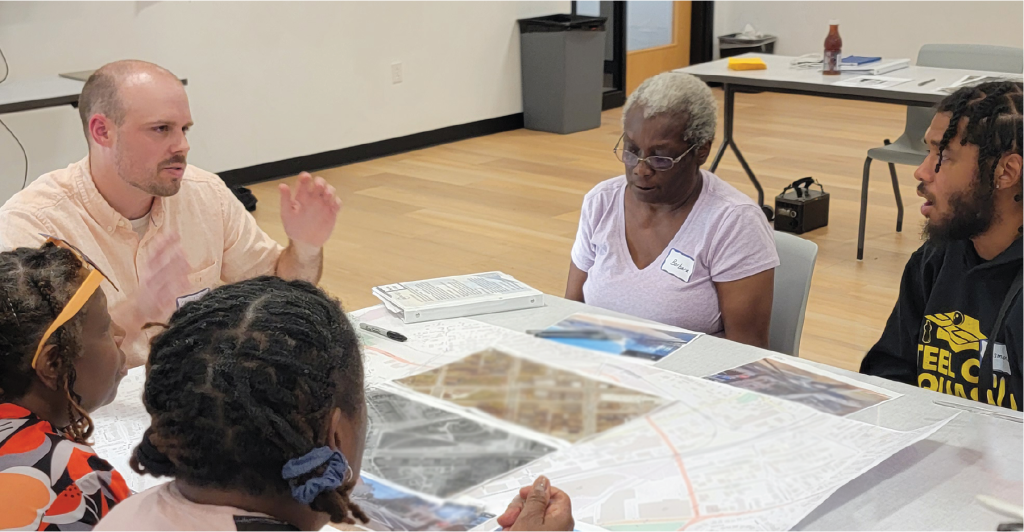
On Tuesday, July 29th, we hosted our seventh Neighborhood Power Building Project (NPP) workshop – part of the collaborative Data Justice for Pittsburgh’s Black Neighborhoodsinitiative between the Black Equity Coalition (BEC) and the City of Pittsburgh – at Steel City Squash in Larimer. This session marked a critical turning point in the project – transitioning from community visioning to selecting specific sites and artistic interventions aimed at reimagining public spaces in Larimer through the lens of equity, safety, and beauty.
The evening began with warm welcomes, food and fellowship, followed by a recap of the last workshop. This included an introduction focusing on specific sites from among those identified in the mapping activity at last month’s workshop. In the June workshop, participants worked with maps and traffic data to identify the intersections and other “hot spots” where they thought artistic traffic calming interventions might be well placed.
Centering Community Voice Through Design
Building on the momentum of last month’s mapping activity this session focused on narrowing down four potential intervention sites among those highlighted during last month’s workshop. Participants also reviewed key factors that would influence final site selections – foot traffic, density, community gathering potential, and feasibility based on permitting or existing infrastructure.
Participants also explored a range of possible “tactical urbanism” interventions for the selected sites, including:
- Surface treatments, such as asphalt murals or painted crosswalks
- Street furniture – a flexible and functional option
- Signage – both directional and artistic
- Programming, such as community-led events or performances
- Landscape elements, including planters
Participants were also asked to reflect on where people naturally gather in the neighborhood. Identifying these spaces helps ensure that the final design choices meet residents where they are, equally prioritizing both form and function. They then divided into two breakout groups, each tasked with evaluating two sites, taking into consideration existing traffic calming measures, adaptability to creative interventions, and proximity to local gathering spots.
Power in Every Voice: A Decision by Design – and by Democracy
Following the first half of the workshop, the participants voted to determine which site would move forward as the first tactical urbanism intervention. Each group presented strong cases, supported by powerful testimonials from residents. Speaking of one particular location, one resident noted the current lack of any existing neighborhood improvement efforts: “There is nothing down there. It would be nice to put something there.” Another observed the opportunity to use artwork to communicate the value of their neighborhood: “The people have nothing to say ‘we mean something too’.”
What’s Next? From Vision to Implementation
Following the vote, the evening concluded with a reflection on the value of natural infrastructure, with participants asked to consider the following question: “What is a benefit to you of the trees around Larimer?” This question will guide next month’s conversation about the role of trees and shade canopies as natural interventions into the built environment of Pittsburgh’s neighborhoods.
As part of the closing, participants were also invited to join a MADE project community art committee, which will help guide implementation of the traffic calming art intervention, and ensure that resident voices remain at the center of related decision-making.
To everyone who contributed your time, your voice, and your vision for Larimer’s future—thank you! Together, we’re not just imagining change, we’re making it visible, vibrant, and lasting!
Stay tuned for updates from the next workshop at: www.BlackEquityCoalition.org.
About the Neighborhood Power Building Initiative:
The Black Equity Coalition (BEC), in partnership with the City of Pittsburgh created the Neighborhood Power Building initiative as part of the broader Data Justice for Pittsburgh’s Black Neighborhoodsproject, designed to empower Black residents with decision-making authority over how data is used, governed, and shared in the city. Pittsburgh is one of four U.S. cities selected for the Modern Anti-Racist Data Ecosystems (MADE) for Health Justice initiative, supported by the de Beaumont Foundation.
As a recipient of the MADE for Health Justice Grant, the BEC decided on our health equity goal: to help residents in Black communities that have been most-impacted by residential segregation and disinvestment in the City of Pittsburgh claim power to improve the quality of housing and the built environment. After a competitive RFP process, we ultimately selected the Larimer Consensus Group (LCG) as a Neighborhood Power Building Partner.