On Thursday, July 24, 2025, we hosted our seventh Community Data Justice Collaborative (CDJC) workshop – part of the collaborative Data Justice for Pittsburgh’s Black Neighborhoods initiative between the Black Equity Coalition(BEC) and the City of Pittsburgh (City).
Held virtually, this session was the second of a two-part summer workshop series with the Public Health Informatics Institute (PHII). PHII is a Georgia-based organization that is working with several of the MADE communities to improve processes through workflow mapping and other analytics. They’re working with the CDJC to assist the Black Equity Coalition, the City of Pittsburgh and the Western Pennsylvania Regional Data Center (WPRDC) to integrate community voices into the City’s open data request process in a more meaningful, inclusive, and transparent manner.
July’s workshop began with warm welcomes and a pre-workshop survey, followed by a recap of the last session on the City’s current state of open data access and reimagining data access in Pittsburgh. This session explored two main objectives:
- Exploring and developing functional requirements for a more transparent and equitable City of Pittsburgh open data request system.
- Exploring how the Western Pennsylvania Regional Data Center engages with the community, with an eye toward future collaboration and community integration.
Justice by Design: Functional Requirements for a Just Data Request System
The first half of the workshop focused on defining the building blocks for a more transparent, user-friendly, and equitable data request process for the City of Pittsburgh. Sheereen Brown from the Public Health Informatics Institute (PHII), led this session with a focus on process mapping and functional design, engaging the group in a discussion that led to their agreement that equitable access must start with a clearly articulated and inclusive request pathway.
Understanding the Current Process
The group reviewed the current data request flow below and diagnosed some weaknesses. Among the group’s observations was that the current data request flow lacks visibility and consistency – consequently, various questions emerged, including whether the public should be able to view past requests and their outcomes, why some requests are denied, and how the process can be made more fair and accountable to the community.
At the start of the session, Ms. Brown walked the group through the difference between business requirements and functional requirements. This helped participants to then engage in a collaborative brainstorming activity outlining key functional requirements of an improved open data request workflow. Some of the notable themes that arose from this discussion included transparency, efficiency, the user experience, and equity. One participant elaborated on this latter point: “Having the data isn’t enough if we can’t use it to solve problems.” The team emphasized that equitable systems must also come with resources and capacity to interpret, apply, and act on the data.
Community Engagement with Civic Data
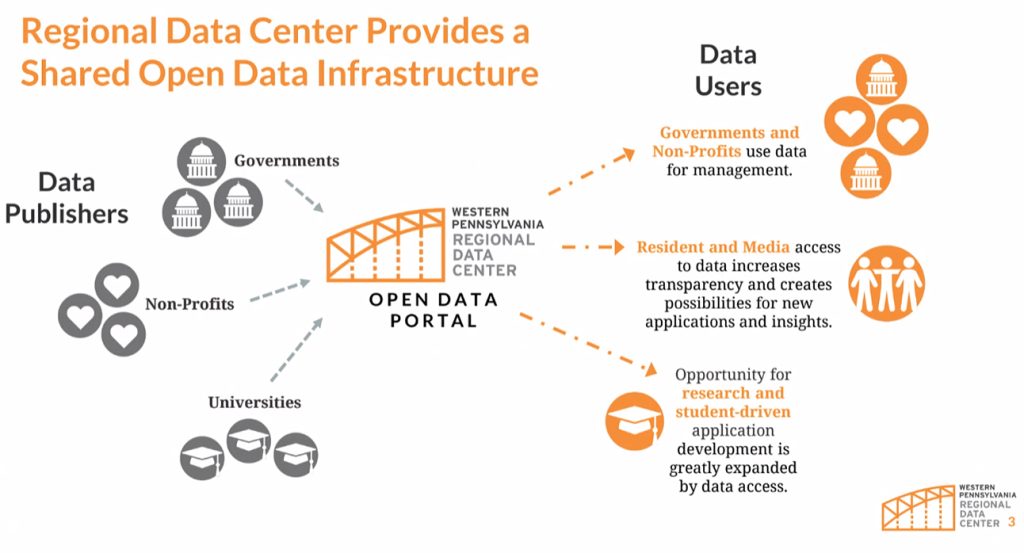
During the second half of the workshop, participants heard from Bob Gradeck and Liz Monk of the Western Pennsylvania Regional Data Center (WPRDC), who shared the organization’s approach to making public data accessible, understandable, and useful to Western Pennsylvania communities.
WPRDC, housed at the University of Pittsburgh’s Center for Social and Urban Research, is celebrating nearly 10 years of stewarding more than 350 public datasets. They receive inquiries and requests for data and other services from:
- Community organization leaders and staff
- Public sector staff
- Residents
- Funders
- Elected officials and candidates
- University faculty, researchers, and students
- Small business owners
- Journalists and data brokers
Fewer than 20% of the requests that the WPRDC receives are for raw data. WPRDC staff have found that most people who reach out are seeking help understanding, using, or applying data for their communities.
The WPRDC offers the following services to the community:
- Providing open data infrastructure
- Data acquisition and transformation services
- Data literacy training
- Technical assistance
- Project-based assistance and special projects
- Support for community initiatives
In addition, they also organize meetings and workshops including user group meetings, help desk consultations, and tabling at events.
Some of the challenges that the WPRDC team face include a lack of capacity to be able to expand data services to meet demand, and connections with trusted people in the wide range of communities present in the County. In order to expand their reach, they asked participants for advice on creating a broader engagement strategy and insights into what future community partnerships could look like.
One of the key takeaways from this discussion was that it is not enough to simply publish data – communities need tools, training, relationships, and agency in the data creation and distribution process. Several CDJC members emphasized the importance of community ownership and participation, particularly those often left out of traditional data ecosystems and immigrant communities.
Looking Forward: A Shared Vision for Data Justice
The session concluded with a call to action: we must center community voices in both the technical and engagement sides of data work. Whether it’s shaping a data request system or expanding civic data literacy, equity must be embedded from the start.
Thank you to our partners at PHII and WPRDC for lending your time, expertise, and commitment to this work. We would also like to thank everyone who joined the discussion, shared ideas, and contributed to shaping a more just and inclusive data landscape for Pittsburgh.
Together, we are building systems that don’t just serve communities but are shaped by them.
Stay tuned for future workshops and initiatives as we continue to shape a more just and equitable future for all at: www.BlackEquityCoalition.org
About the Community Data Justice Collaborative (CDJC):
The Black Equity Coalition (BEC), in partnership with the City of Pittsburgh created the Community Data Justice Collaborative (CDJC) as part of the broader Data Justice for Pittsburgh’s Black Neighborhoods project, designed to empower Black residents with decision-making authority over how data is used, governed, and shared in the city. Pittsburgh is one of four U.S. cities selected for the Modern Anti-Racist Data Ecosystems (MADE) for Health Justice initiative, supported by the de Beaumont Foundation. The de Beaumont Foundation sponsored the BEC’s work to assist in accelerating the development of health-focused local data ecosystems that center principles of anti-racism, equity, justice, and community power.
The Community Data Justice Collaborative is a group of residents who engage in decisions that the City of Pittsburgh makes about data, technology, and policies that will serve as the foundation of the City’s emerging data governance process. The BEC will engage the Community Data Justice Collaborative and city data stewards in participatory activities to find agreement around how the city uses data and technology.