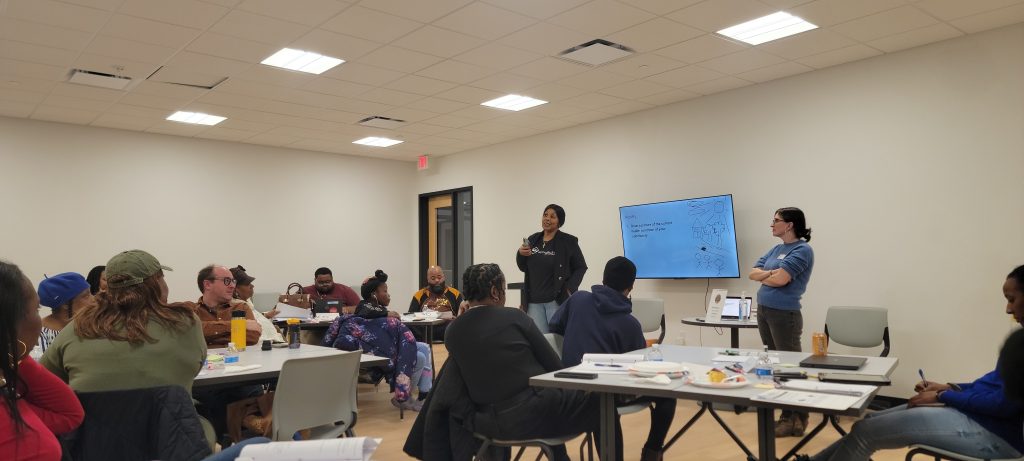
The Black Equity Coalition (BEC), in partnership with the City of Pittsburgh, successfully held the second Neighborhood Power Building workshop at Steel City Squash in Larimer. This workshop brought together passionate Larimer community members to discuss pressing neighborhood issues, voice their concerns, and collaborate on solutions for a stronger, healthier community. Through engaging activities and open discussions, participants explored the strengths and challenges of their neighborhood while identifying actionable steps to drive meaningful change.
Welcome & Icebreaker: Rose, Bud and Thorn
The evening kicked off with a warm welcome, reviewing Group Norms and introductions, setting the tone for an interactive and engaging workshop. The Rose, Bud, and Thorn icebreaker encouraged participants to reflect on their community:
- Roses (What they like): Camaraderie, friendly neighbors, walkability, and a strong sense of community, etc.
- Buds (What’s missing): More youth-focused activities, a community center for health & wellness, and business opportunities, etc.
- Thorns (What’s needed): More affordable housing, mental health services, improved police response, access to healthy food, improved community resources, and better management of vacant land and vacant homes.
Participants passionately shared their experiences, highlighting the love they have for Larimer while also acknowledging areas that need urgent attention.
Project Re-Introduction: Data Justice & Community Empowerment
The workshop revisited the overarching goals of the Neighborhood Power Building initiative, emphasizing the importance of Data Justice—a framework that ensures community voices, knowledge, and experiences are valued in data collection and decision-making. Our goals include:
- Giving communities power to decide what data gets counted, how it’s collected, and how it’s used.
- Ensuring equitable storytelling and representation in data narratives.
- Informing participants about the MADE for Health Justice Program
- Improving health outcomes in Larimer
- Developing a new model for community data use in Pittsburgh, Using creative approaches, such as engaging artists, to explore new ways of working with data to build community power.
Residents in the room then started a discussion about where they turn for information about the neighborhood. They expressed frustration having to navigate so many online spaces, and talked about ways that information could be made more-available online and offline.
Drawing Activity: Visualizing Larimer’s Current Health
Participants illustrated their perceptions of Larimer’s current state, highlighting:
- Challenges: Broken streetlights, untrimmed trees, potholes, lack of recreational spaces, vacant lots, and unfulfilled community promises,etc.
- Hopes for improvement: Better water infrastructure (fountains and bathrooms), bleachers for community spaces, and clear accountability for moving neighborhood projects forward, etc.
- Community concerns: The impact of mental health challenges, particularly among youth, and the need for more structured guidance and mentorship opportunities, etc.
Looking Ahead: Continuing the Conversation
As the workshop concluded, participants expressed their commitment to speaking up and working together to ensure progress in Larimer. The Neighborhood Power Building Initiative will continue to create spaces for dialogue and action, fostering a stronger and more connected community. Together, we can turn challenges into opportunities and build a Larimer that reflects the needs and dreams of its residents.
Stay tuned for updates as we continue this journey toward data justice and community-driven change at: www.BlackEquityCoalition.org
About the Neighborhood Power Building Initiative:
The Black Equity Coalition (BEC), in partnership with the City of Pittsburgh created the Neighborhood Power Building initiative as part of the broader Data Justice for Pittsburgh’s Black Neighborhoods project, designed to empower Black residents with decision-making authority over how data is used, governed, and shared in the city. Pittsburgh is one of four U.S. cities selected for the Modern Anti-Racist Data Ecosystems (MADE) for Health Justice initiative, supported by the de Beaumont Foundation.
As a recipient of the MADE for Health Justice Grant, the BEC decided on our health equity goal: to help residents in Black communities that have been most-impacted by residential segregation and disinvestment in the City of Pittsburgh claim power to improve the quality of housing and the built environment. After a competitive RFP process, we ultimately selected the Larimer Consensus Group (LCG) as a Neighborhood Power Building Partner.