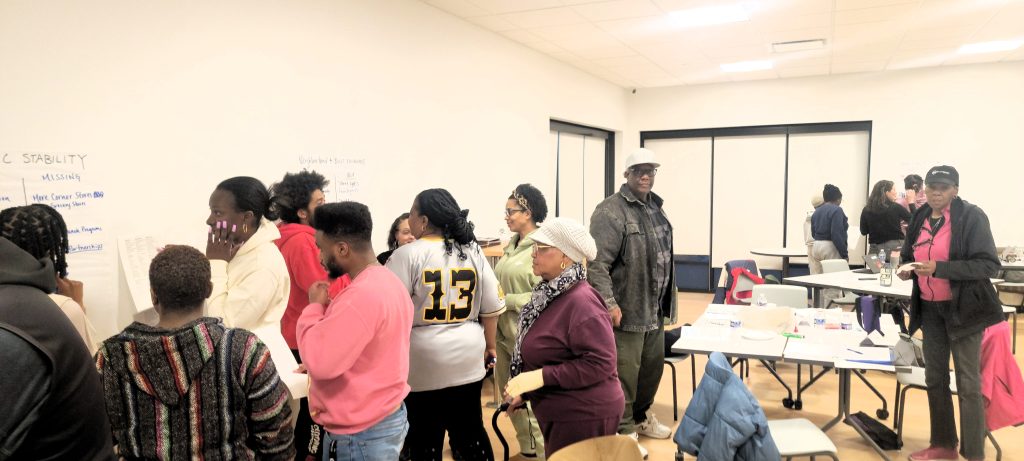
On March 25th, the Black Equity Coalition (BEC) and the City of Pittsburgh convened the third Neighborhood Power Building workshop at Steel City Squash. Our activities are designed to build a new model for how data is used to improve the well being of neighborhood residents and builds their power for action. Our partner in this effort is the Larimer Consensus Group. The goal of this third workshop was to introduce the concept of Social Determinants of Health (SDOH) to our participants.
Setting the Stage
The evening began with warm welcomes, food and fellowship, followed by a recap of the last workshop. This included an introduction to the artist Tacumba Turner, who will join the project team to incorporate art and participatory activities into the initiative.
Unpacking Health and Its Determinants
The workshop opened with the question: “what do you think influences life expectancy?” This helped set the foundation for the presentation by members of Carnegie Mellon’s CREATE Lab, who talked about the SDOH which is a helpful framework for explaining all of the different factors that influence our health. Health is determined by many different social, economic, and environmental factors. The presentation and discussion led by CREATE Lab introduced the five SDOH identified by the U.S. Department of Health and Human Services. In their presentation, they described each of the SDOH, and also shared examples of how each can be measured in Pittsburgh. The five SDOH include:
- Healthcare Access and Quality can be measured by affordability, availability of insurance, access to doctors, hospitals, and other care providers, availability of medicine, and how welcome and respected people feel when receiving health care.
- Education Access and Quality – People who live longer tend to have higher levels of education. Education access and quality can be measured in a number of ways, including the range and diversity of educational opportunities available to all learners, education budgets, developmental readiness, student performance, enrollment, experience of educators, educational attainment, and how safe, engaged, respected, and welcome students feel.
- Economic Stability – Steady jobs that provide adequate income help to provide people with what they need to stay healthy. This can be measured by unemployment statistics, data on wages and income, numbers of jobs (and informal work opportunities), and neighborhood economic opportunities.
- Social and Community Context indicators can measure the relationships people in a community have with one another. Common indicators include community needs, available community organizations and programs, and surveys that measure quality of life and satisfaction.
- Neighborhood and Built Environment is the focus of our work in Larimer. We will influence the health, well-being, and safety of community members through improvements in the built environment. We plan to use data about traffic safety, land use and housing, the natural environment, and recreational opportunities in this initiative..
Following the presentation, participants engaged in thought-provoking discussions using Larimer as a case study to examine how key issues fit within the SDOH framework. For each determinant of health, we examined “what data we might look at” and “what can we not look at that we wish we could?”
Community Voices and Perspectives
A particularly impactful moment from the workshop was the group activity, Categorizing Social Determinants of Health in Larimer, where attendees were asked to take the listing of things that Larimer has or is missing created in our second workshop, and map them to the Social Determinants of Health. Participants then shared their insights and findings with one another.
Looking Ahead: Turning Insight into Action
The third workshop reaffirmed the power of community knowledge and the need for data-driven advocacy. By working together, we can transform these insights into meaningful change, ensuring that Larimer and its residents thrive for generations to come.
Stay tuned for our updates as we take the next steps in building neighborhood power and lasting change at: www.BlackEquityCoalition.org
About the Neighborhood Power Building Initiative:
The Black Equity Coalition (BEC), in partnership with the City of Pittsburgh created the Neighborhood Power Building initiative as part of the broader Data Justice for Pittsburgh’s Black Neighborhoods project, designed to empower Black residents with decision-making authority over how data is used, governed, and shared in the city. Pittsburgh is one of four U.S. cities selected for the Modern Anti-Racist Data Ecosystems (MADE) for Health Justice initiative, supported by the de Beaumont Foundation.As a recipient of the MADE for Health Justice Grant, the BEC decided on our health equity goal: to help residents in Black communities that have been most-impacted by residential segregation and disinvestment in the City of Pittsburgh claim power to improve the quality of housing and the built environment. After a competitive RFP process, we ultimately selected the Larimer Consensus Group (LCG) as a Neighborhood Power Building Partner.