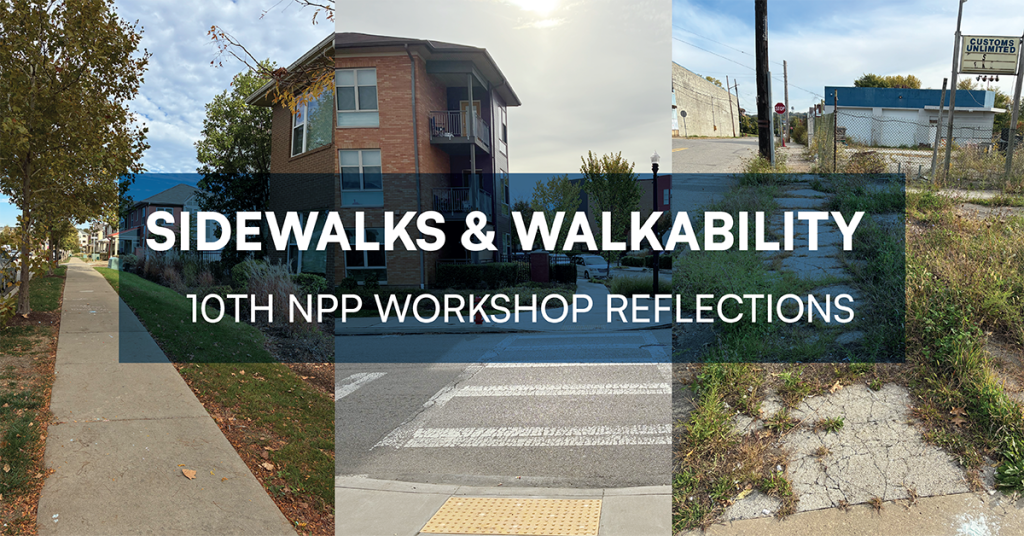
On Tuesday, October 28th, we hosted our tenth Neighborhood Power Building Project (NPP) workshop—part of the collaborative Data Justice for Pittsburgh’s Black Neighborhoods initiative between the Black Equity Coalition (BEC) and the City of Pittsburgh—at Steel City Squash in Larimer. This session focused on the impact that improved sidewalks can have on walkability and community health.
Dr. Tiffany Gary-Webb and Dr. Noble Maseru of the University of Pittsburgh started the meeting by highlighting characteristics of what makes a community truly walkable. Walkable communities have continuous networks of sidewalks that are free of obstructions, safe places to cross the street, and many attractive destinations like schools, parks, and businesses. Improving walkability can improve well-being by improving safety, increased physical activity, enhanced social interaction, and reducing things that cause stress.
Walk scores are one measure that has been developed to assess walkability of a community by the Walk Score company. Walk scores use data such as population density, proximity to destinations, and block length and density of intersections in its algorithm. Since sidewalk condition data is not uniformly available, it is not included in the creation of walk scores. Larimer’s walk score of 77 is one of the higher walk scores among Pittsburgh neighborhoods and is defined as a “Very Walkable” community, meaning that most errands can be performed by walking. Downtown Pittsburgh’s score of 92 places it firmly in the “Walker’s Paradise” category. In the hilly southern part of the City, the Carrick neighborhood’s walk score of 54 highlights the need for someone living there to have alternate modes of transportation to have a high quality of life.
Jan Raether and Chris Belasco of the City of Pittsburgh then shared more information about sidewalks in Pittsburgh. The City sees sidewalks as a valuable public infrastructure, as just about everyone is a pedestrian and benefits from usable and safe sidewalks. Walkability often can mean different things for different people – someone using a wheelchair, pushing a baby stroller, or someone with low vision do not have the same experiences using a sidewalk as someone who faces comparatively few limitations.
One of the things that makes sidewalks a difficult issue to address at the city level is that maintaining them is the responsibility of the adjacent property owner. Property owners often struggle with the expenses needed to maintain and replace sidewalks in disrepair, and the City prefers to work collaboratively with property owners to improve sidewalk condition. One program created by the city to improve vital sidewalks is called the Critical Sidewalk Gaps program, which covers expenses to manage and replace sidewalks that serve as key connections to community destinations, including schools, transit stops, business districts and parks. Projects in and around Larimer completed via the Critical Sidewalks Program include (in 2023) Ashley Street, (in 2024) Broad Street and East LIberty Boulevard, and (in 2025) Larimer Avenue.
To identify sidewalks in need of maintenance, the City has partnered with a number of organizations including Bike Pittsburgh and Pittsburgh Walks to collect data about sidewalk conditions through “sidewalk audits.” In the audit process, volunteers use mobile phones to collect data on where sidewalks could be improved. After going through training, volunteers collect data and become advocates for improved infrastructure in neighborhoods. It is important to note that the City is not using data from these audits for enforcement, only planning, and encourages people to use the 311 non-emergency request process to report dangerous sidewalk conditions to the City.
Following the City’s presentation, Bob Gradeck from the University of Pittsburgh showed several photos of sidewalks in Larimer to spark a conversation about how sidewalks impact participants behavior and quality of life. Residents told stories about how they have fallen on poorly-maintained sidewalks, and how they often walk in the street to avoid using them. They also talked about how sidewalks next to vacant property are less-likely to be well-maintained, and shared the challenge of maintaining and repairing sidewalks near them, including winter maintenance.
The Larimer Consensus Group already has been working with community members to address sidewalk conditions, and is interested in participating in the audit process with community members in the room also thought audits would be a great way to engage young people in efforts to improve the community. The City will attend an upcoming meeting of the Consensus Group to share information about how to take part in the audit process.
Our November meeting will explore the impact that lighting can have on walkability and well-being in a community. Quality lighting can improve community safety, invite people to be outside at night, and improve visibility of the night sky.