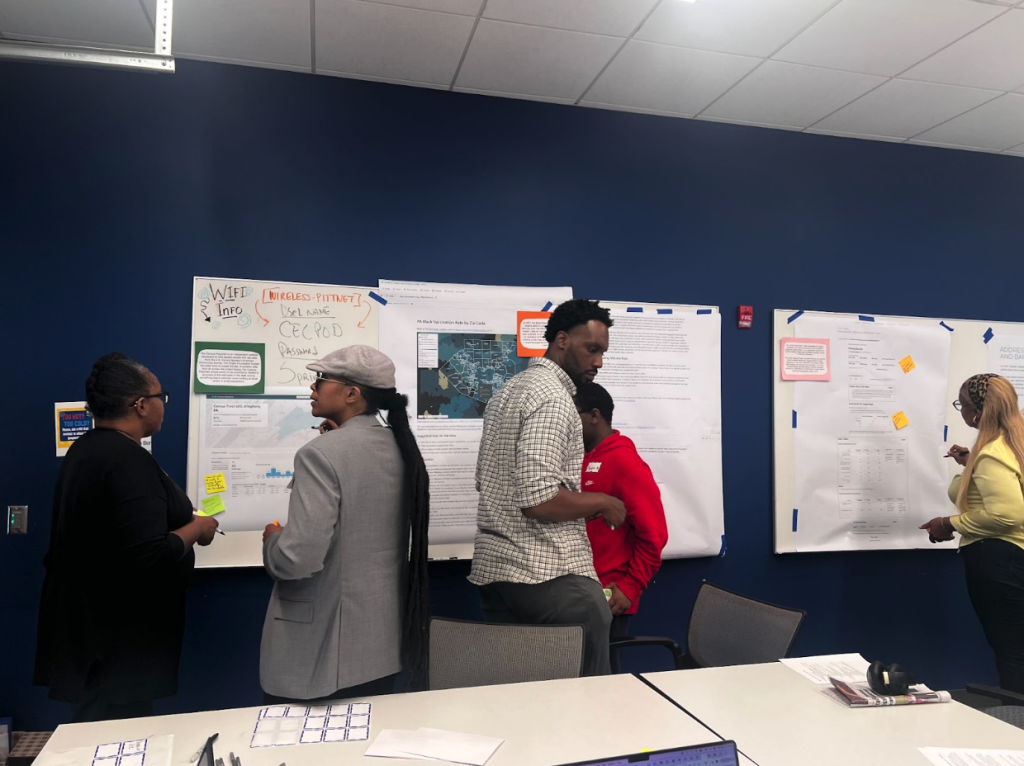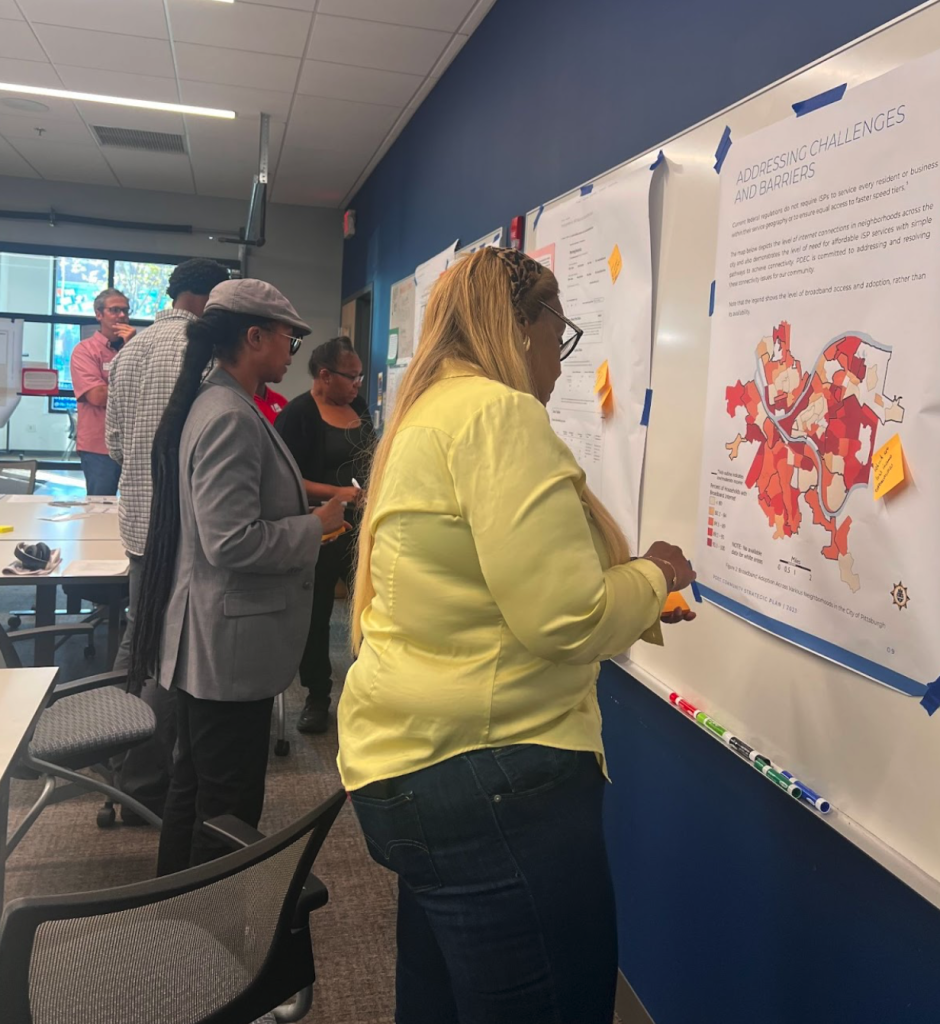
On Thursday, September 18, 2025, the Black Equity Coalition (BEC) hosted the ninth Community Data Justice Collaborative (CDJC) workshop as part of the Modernizing Anti-Racist Data Ecosystems (MADE) for Health Justice initiative. The workshop took place at the University of Pittsburgh Community Engagement Center in Pittsburgh’s Homewood neighborhood and marked the second session in a series dedicated to advancing equity in civic data visualizations.
At the heart of this effort is the CDJC’s ongoing work to co-create a set of principles to guide how the City of Pittsburgh designs and communicates public data – both internally and externally – in ways that are accessible, transparent, and community-centered.
Opening Reflections: Data, Equity, and Partnership
The session began with remarks from Dr. Noble Maseru, Professor of Public Health Practice and Director of Social Justice, Racial Equity, and Faculty Engagement at the University of Pittsburgh’s Schools of Health Sciences. Dr. Maseru traced a line between historical justice movements and the present-day urgency of equity in policy and data systems. He emphasized that equity is not a threat to most people – only to systems that depend on inequality – and called on CDJC members to approach this work as partners in civic leadership, helping ensure that the use of data by the City translates into tangible, equitable outcomes for the community.
From Observation to Insight: A Gallery Walk in Practice
Following the opening remarks, CDJC members Gabby Gray (Pittsburgh United) and Alexander Payton (The Kingsley Association) led participants through a gallery walk of civic data visualizations, which they had co-designed using principles drawn from the Urban Institute’s Do No Harm Guide by Jonathan Schwabish and Alice Feng. The walk invited participants to reflect broadly on the communicative power of data and the conditions required for that communication to be meaningful and just.
Participants considered issues of visibility and omission, audience and purpose, and the often-unspoken assumptions embedded in visual formats. The group explored how design choices shape the story a visualization tells, who is able to see themselves in the data, and who might be left out. Context, clarity, accessibility, and cultural relevance all emerged as critical themes.
Debrief and Reflection: Grounding Principles in Practice
The group then reconvened for a full discussion and debrief, where reflections began to coalesce into early-stage principles for equitable design. Participants emphasized the importance of contextual framing, especially when data might be used to make judgments about communities. They also discussed the role of the audience, recognizing that while data is often designed for institutional use, its impacts are often most deeply felt by the public.
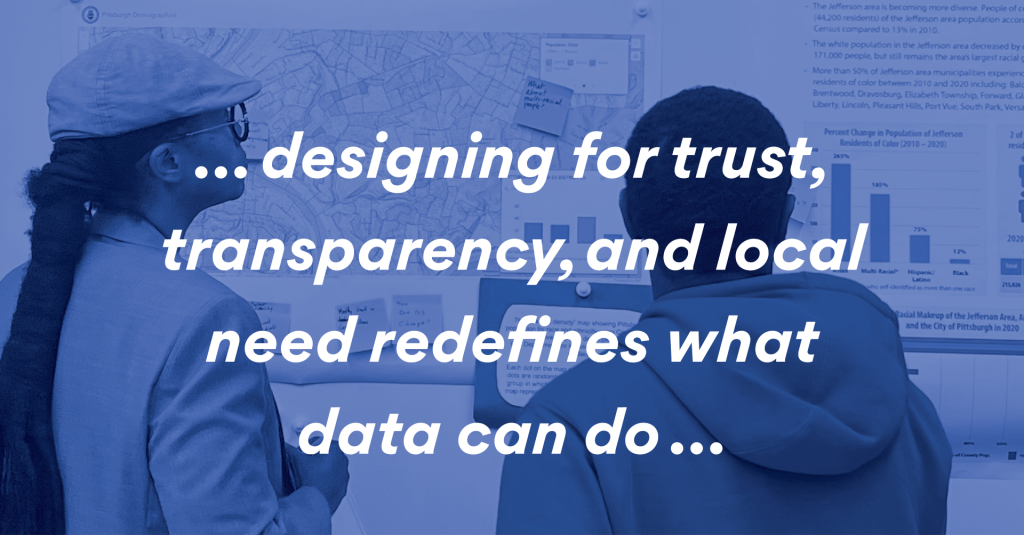
A central point of reflection involved lessons from the early stages of the COVID-19 pandemic. During that time, race was often omitted from health data, masking the disproportionate burden of the virus on Black communities. Even when collection was possible, lack of trust in data systems led some to withhold their racial identity – an issue that was addressed through Black-led, community-based outreach and advocacy. That experience underscored the importance of designing not just for technical accuracy, but for trust, transparency, and local need.
Themes emerging from the discussion included:
- The need for design to support community interpretation and ownership
- The importance of acknowledging multiple ways of knowing
- The tension between accessibility and technical complexity
- The value of flexibility when working with layered or intersecting datasets
Looking Ahead: Responsive, Collaborative Design
This session underscored that community-centered design takes time and flexibility. The depth and quality of discussion made it clear that a single workshop would not be sufficient to complete this phase of work. Recognizing this, CDJC members and BEC staff agreed to schedule a follow-on session in the coming weeks, ensuring that the group’s insights are thoroughly reflected in any resulting style guide or visualization principles.
This kind of work – innovative, nuanced, and in many ways unprecedented – requires patience, trust, and responsiveness to the complexity of the questions being asked. It is not common practice for cities to invite residents to shape their data visualization practices, but the CDJC is demonstrating why that invitation matters, and what becomes possible when it’s made in good faith.
About the Community Data Justice Collaborative (CDJC):
The Black Equity Coalition (BEC), in partnership with the City of Pittsburgh, created the Community Data Justice Collaborative (CDJC) as part of the broader Data Justice for Pittsburgh’s Black Neighborhoods project, designed to empower Black residents with decision-making authority over how data is used, governed, and shared in the city. Pittsburgh is one of four U.S. cities selected for the Modern Anti-Racist Data Ecosystems (MADE) for Health Justice initiative, supported by the de Beaumont Foundation. The de Beaumont Foundation sponsored the BEC’s work to assist in accelerating the development of health-focused local data ecosystems that center principles of anti-racism, equity, justice, and community power.
The Community Data Justice Collaborative is a group of residents who engage in decisions that the City of Pittsburgh makes about data, technology, and policies that will serve as the foundation of the City’s emerging data governance process. The BEC will engage the Community Data Justice Collaborative and city data stewards in participatory activities to find agreement around how the city uses data and technology.