On Thursday, November 20, 2025, Members of the Community Data Justice Collaborative met online to continue discussion of data visualization principles and begin a conversation about data privacy.
Data Visualization
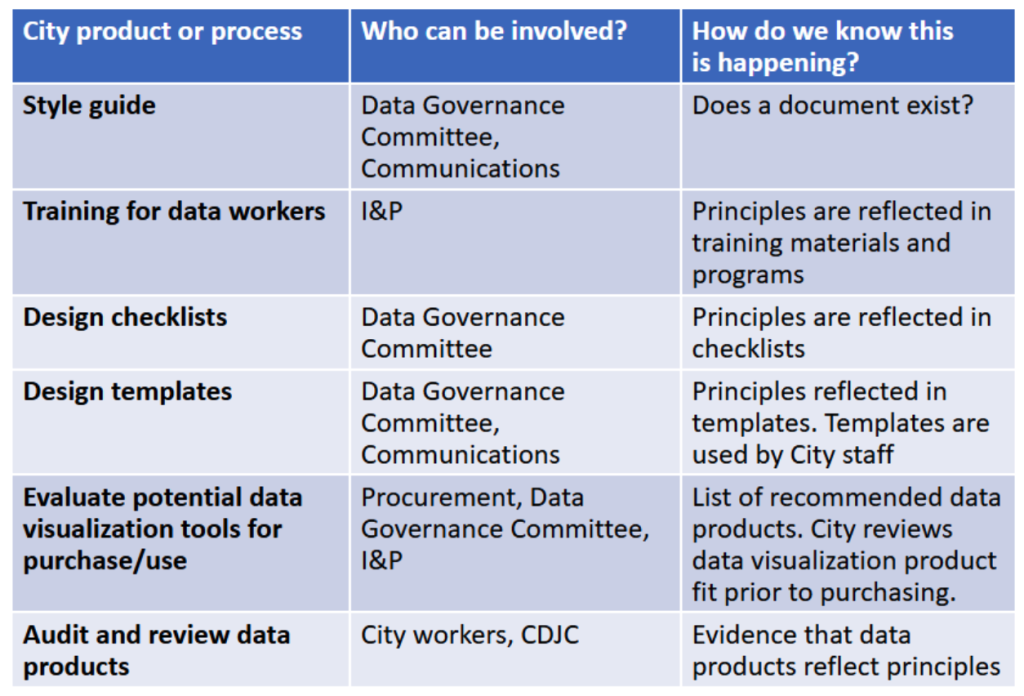
The previous two meetings of the group were held in person and featured a gallery walk, where members were able to view data visualization examples, post comments, and have a conversation about them with others in the room. Each meeting featured the same visualization and format for discussion, and two meetings were held so that everyone was able to participate in the activity. These activities were designed to create a set of principles that can be used by the City of Pittsburgh when developing data products and creating data visualizations. These principles can be incorporated into staff training, design checklists, a style guide, design templates, and software purchasing decisions, as described in the following table.
Figure 1: Ways to activate data visualization principles
The project team with the Black Equity Coalition synthesized the discussion from the gallery walk and other activities, and shared them with members of the Collaborative. During a discussion in the November meeting, members suggested a few modifications, and the full list of principles appears below.
- Critically examine your data;
- Include context about data. This context can include limitations, background, power dynamics, and other related data or overlays;
- Structural causes should be listed or described in visualizations about disparity;
- Share reasons why there is missing data in addition to describing what’s missing;
- Communicate uncertainty in the data;
- Approach work from a place of empathy – remember that data describes people;
- Focus on accessibility:
- accommodate people with disabilities;
- use accessible colors;
- consider the devices that people may use;
- communicate using plain language;
- adopt language justice principles;
- meet the needs of people who aren’t data and technology experts.
- Engage community members to ensure that their lived experience is reflected in data visualizations and products;
- Understand your audience including their needs and expectations;
- Articulate the purpose of the visualization or product, including the issue it may be trying to address;
- Avoid hierarchy when visualizing people or communities.
The group will continue to work to ensure that these principles are incorporated into the City’s data practices.
Data Privacy
To kick-off the topic of data privacy, City of Pittsburgh Chief Data Officer was joined by Will Tang, NobleReach Fellow with the City of Pittsburgh’s Data Services team. Will is focused on establishing AI governance and data policies in his role at the City.
In their presentation, Chris and Will shared information about current City data protection practices, provided details on the current state of privacy policy, took questions from the group, and talked about how they could have an impact on the City’s policy through the development of privacy principles.
The City currently uses the Personally Identifying Information and Data Classification Standard established by the National Institute of Standards and Technology to define what is personally-identifiable information.
The City has established sensitivity levels of “public,” “private,” and “restricted” and applies these labels to datasets through its data inventory process.
The City protects sensitive data in a number of ways, including: encrypting data that is stored and transferred; requiring authentication and permissions to access; establishing data sharing agreements to share private data; and desensitizing data that is shared with the public.
Although these safeguards offer protections, the City does not have a standalone privacy policy. Current policies in City Ordinance Title 6 cover public security camera systems and employee email privacy. An additional item in City Ordinance Title 3 regulates use of facial recognition software (text).
- Chris and Will shared that cities who effectively incorporate community input into their privacy policies typically:
- Solicit community feedback;
- Incorporate feedback into privacy principles;
- Work to turn principles into policy (which takes longer than developing principles);
- Create ongoing processes for disclosure and public comment;
- Adopt a “privacy by design” approach through the entire process.
- Cities that they highlighted as notable examples include:
- Portland Oregon, which built their program in partnership with the city’s Office of Equity and Human Rights. Portland requires Privacy Impact Assessments for projects using sensitive data, banned use of facial recognition technology, and provides equity centered policy information, transparent documentation, and has created feedback loops for public input.
- San Jose California’s policy was developed by a diverse task force, which meets at least twice each year, and is involved in discussions about major projects.
- Long Beach California partnered with community organizations as part of a broader multi-lingual engagement strategy. Following Council approval of privacy guidelines, the principles were embedded into smart city governance practices.
- Chris suggested that the CDJC could be helpful in (at least) the following ways:
- Convening community conversations
- Providing direct input
- Testing
- Meeting to identify technology relevant to policy scope
- Accountability and measuring success.
The members next moved into a discussion on the topic of privacy.
- Members of the CDJC were interested in learning more about what kinds of incidents have led to the need for privacy policies in cities and were interested in learning more about harms that were caused by the lack of robust policies and practices.
- They also wanted to learn more about right to know laws in Pennsylvania and what disclosure is mandatory.
- Members also were eager to learn more about specific things like police mugshots, use of AI, license plate data policies, and what rules apply to video and audio.
The group will continue to explore these topics in meetings next year. In December, the group will get together with participants in the Neighborhood Power Building Project to share a meal and their experiences in the Data Justice for Black Pittsburgh initiative.