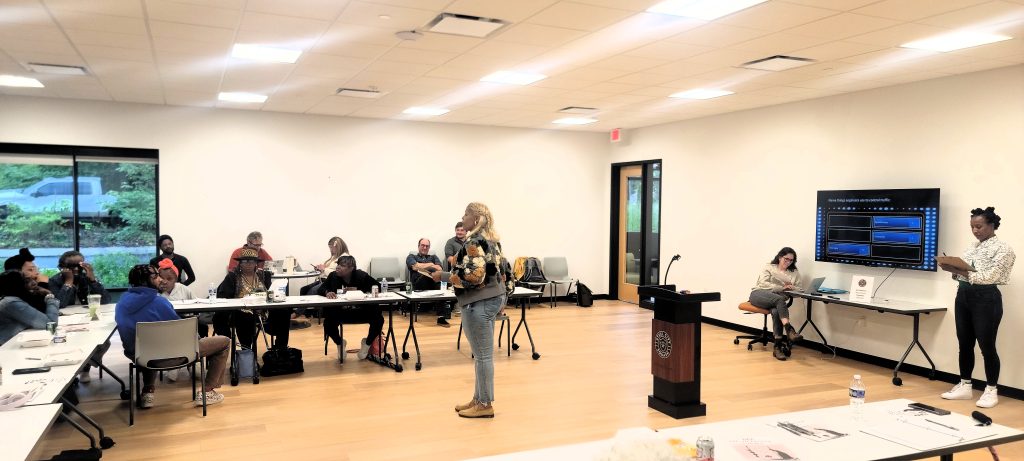
On Tuesday, May 27th, we hosted our fifth Neighborhood Power Building Project (NPP) workshop—part of the collaborative Data Justice for Pittsburgh’s Black Neighborhoods initiative between the Black Equity Coalition (BEC) and the City of Pittsburgh—at Steel City Squash in Larimer. This session focused on a critical yet often overlooked aspect of community well-being: street safety and its impact on public health.
Traffic Calming and Public Health
Led by presenters from the City of Pittsburgh’s Department of Mobility and Infrastructure (DOMI), City Planning, Department of Innovation and Performance, and the Office of Neighborhood Services, the workshop introduced traffic calming as a set of street design strategies aimed at slowing vehicle speeds and creating safer environments for all road users.
We explored how traffic calming relates directly to Vision Zero—an international commitment to eliminate traffic fatalities and serious injuries, which Pittsburgh adopted through a resolution championed by Mayor Gainey and passed by City Council. Vision Zero emphasizes that safe streets are a shared responsibility involving agencies like the Department of Mobility and Infrastructure (DOMI), PennDOT, and City Planning. Vision Zero brings agencies and the public to work together to advance our goal of zero traffic deaths through a holistic approach to roadway design, education, policy and other changes that uphold a commitment to safety.
During this presentation, the group reviewed data on crash hotspots, discussed streets on the city’s listing of roads that have higher levels of crashes and injuries (the High Injury Network), and considered which Larimer streets—such as: Larimer Ave, Paulson Ave., and East Liberty Blvd.—may be eligible for future traffic calming actions.
The data about the human toll of unsafe streets in Pittsburgh is sobering:
- In 2024 alone, 17 fatalities occurred on crashes that involved pedestrians on Pittsburgh streets.
- Since 2020, crashes are up 40%.
- At 20 mph, there’s an 8% fatality rate for pedestrians hit in crashes; at 40 mph, that jumps to 46%.
- 10% of the roads in Pittsburgh are responsible for 83% of all serious injury crashes, 79% of all pedestrian crashes, and 62% of all bicycle crashes.
This data underscores why slowing down traffic is not just a transportation issue—it’s a public health and equity imperative.
Designed to Drive: How Streets Shape Behavior
Furthermore, the presenters walked attendees through why drivers often speed—even unintentionally. We learned that:
- People drive based on the “feel” of the road, not posted speed limits.
- Drivers go faster the “simpler” it feels to drive on a road.
- Wider roads, minimal visual cues, and long sightlines invite faster driving.
- Streets in highly built-up areas like parts of Penn Avenue Downtown naturally slow traffic due to their complex design and high degree of activity.
They also learned how effective traffic calming changes the street itself—by using tools like:
- Speed bumps and speed tables (these slow traffic by 7+ mph)
- Narrowed roads (2.5+ mph reduction)
- Raised crosswalks, bump-outs, and roundabouts
- Zoning changes that reimagine how streets are used and who they serve
Moreover, participants also learned about the request and selection process on the City’s Traffic Calming requests with the City by submitting a 311 request.
The City of Pittsburgh’s Department of Mobility and Infrastructure (DOMI) prioritizes:
- Speed and traffic volume
- Equity (newly added to the evaluation tool)
- Crash history and pedestrian generators like schools and senior centers
Even if a street isn’t selected immediately, it stays on the list and can gain traction through resident advocacy and participation in City Council budget meetings.
Think Fast, Drive Slow: Larimer Family Feud
To bring the data and insights to life, the session wrapped up with an interactive group activity, a lively game of Family Feud, Neighborhood Power Building edition! Participants teamed up in two groups to answer various questions about:
- Tools used to calm traffic
- Dangerous streets in Pittsburgh
- What counts as part of the built environment
- How community members can raise concerns and advocate for change
Questions ranged from “What streets in Larimer are on the High Injury Network?” to “What can community members do to advocate for change?” The game wasn’t just fun—it was powerful peer learning, connecting facts with lived experience and data from our very own streets.
Final Reflections
We concluded this month’s workshop with remarks from Dr. Noble A-W Maseru, who reminded us that building safer streets is also about shifting perceptions and addressing the vital signs of our community—life expectancy, infant mortality, job access, and more. It’s about systemic change, not surface fixes.
Participants were then encouraged to complete post-workshop surveys, advocate for traffic calming projects by submitting requests and contacting elected officials, and most importantly—to keep showing up for their community.
We would like to thank everyone who attended—thank you for showing up, speaking up, and sharing space. Your insights, questions, and lived experiences are what make these workshops meaningful!
Together, we’re building stronger, safer neighborhoods—one workshop, one connection, one block at a time.
Stay tuned for updates from the next workshop at: www.BlackEquityCoalition.org.
About the Neighborhood Power Building Initiative:
The Black Equity Coalition (BEC), in partnership with the City of Pittsburgh created the Neighborhood Power Building initiative as part of the broader Data Justice for Pittsburgh’s Black Neighborhoods project, designed to empower Black residents with decision-making authority over how data is used, governed, and shared in the city. Pittsburgh is one of four U.S. cities selected for the Modern Anti-Racist Data Ecosystems (MADE) for Health Justice initiative, supported by the de Beaumont Foundation.
As a recipient of the MADE for Health Justice Grant, the BEC decided on our health equity goal: to help residents in Black communities that have been most-impacted by residential segregation and disinvestment in the City of Pittsburgh claim power to improve the quality of housing and the built environment. After a competitive RFP process, we ultimately selected the Larimer Consensus Group (LCG) as a Neighborhood Power Building Partner.