
Less stigma. Earlier answers.

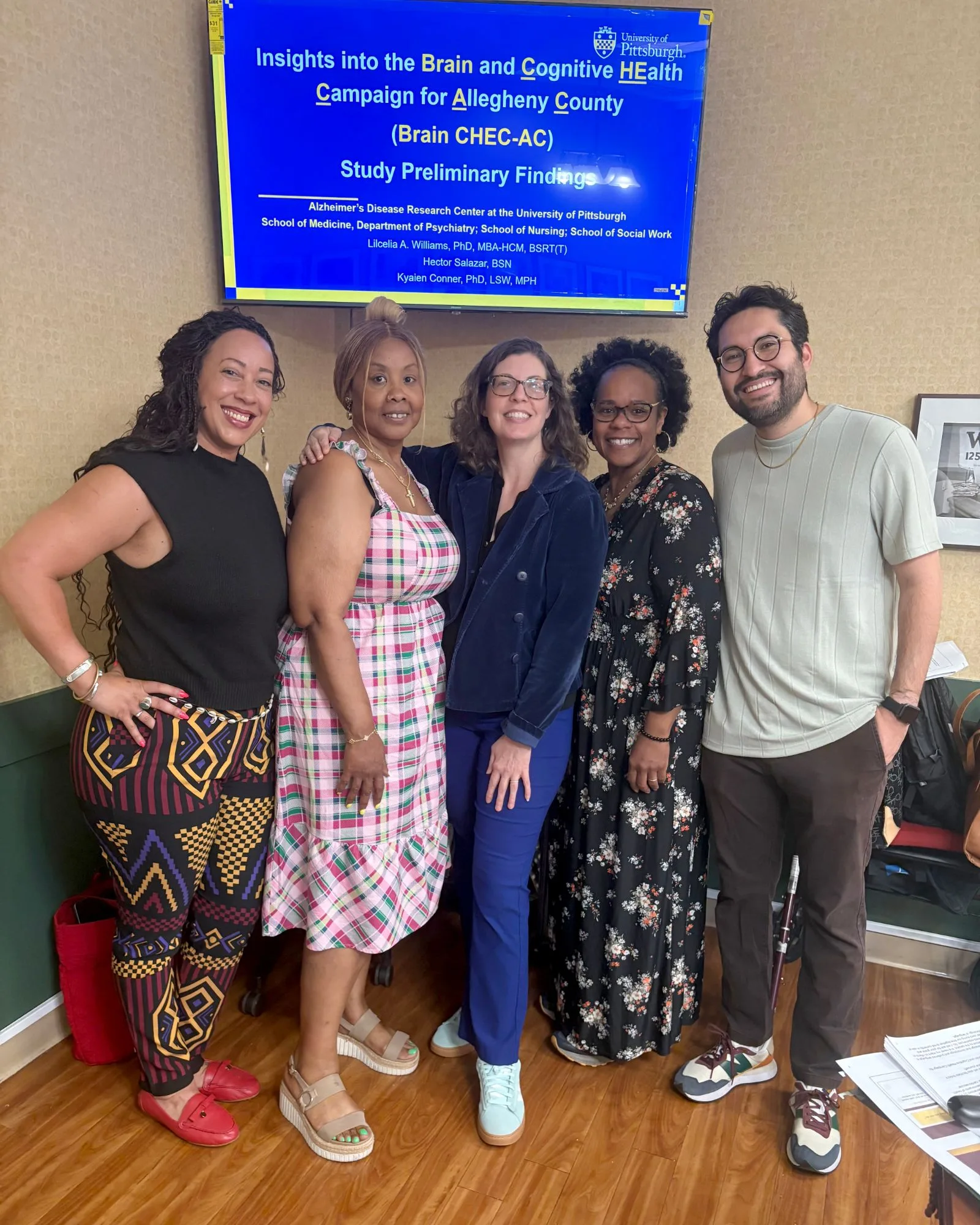
Brain CHEC-AC, the Brain and Cognitive Health Equity Campaign for Allegheny County, is a project aiming to tackle stigma around Alzheimer’s disease and dementia, with the goal of promoting earlier detection of these disorders in Black and Brown communities in Allegheny County.

The project is led by a research team at the University of Pittsburgh, supported by a federal research grant, in partnership with the Black Equity Coalition and the Allegheny County Health Department.

From purpose to practice.

A woman in a black sleeveless top gestures as she speaks to a group seated around tables in a community room, with printed handouts on a pool table in the foreground.

Fight stigma. Share community stories.

The project works to fight the stigma surrounding Alzheimer’s disease and related dementias while providing accessible cognitive evaluations. Trained interviewers gather community members’ stories about dementia to shape messages that challenge stereotypes, with BEC helping reach the places where people live, work, play, and age.


A caregiver holds the hands of an older Black man seated on a couch, offering support.

Find memory concerns early.

Identifying mild cognitive impairment or memory concerns early connects people to advanced clinical care and emerging therapies. Researchers are also exploring blood-based biomarker testing, a research test that could be done in community settings.

Why brain health
equity matters.

According to the Alzheimer’s Association, in its 2025 report:

7M+

Americans are living with Alzheimer’s dementia

Alzheimer’s Association, 2025
1 in 9

people age 65 and older (11%) have Alzheimer’s dementia

From 5.1% at ages 65–74 to 33.4% at 85 and older
2×

Black older adults are about twice as likely as White older adults to have Alzheimer’s or other dementias

Genetic factors do not explain the difference
12M

Americans provide unpaid care for a family member or friend with dementia

A contribution valued at more than $413 billion

Social factors matter.

Genetic factors do not explain these large differences in prevalence. Differences in life experiences, social and environmental indicators, and health conditions are increasingly believed to influence brain health as we age.

While the role of these factors is complicated and requires further study, the team at Pitt believes that stigma is one social factor that can be addressed to begin promoting better brain health in local communities.

Get a free memory evaluation.

Pitt’s Alzheimer’s Disease Research Center offers a no-cost outpatient memory evaluation, about four hours long, for adults noticing changes in memory or thinking, and for adults 60 and older without memory concerns. A study partner is required.

412-692-2700

Learn more and apply

Partnership makes
progress possible.

University of Pittsburgh
Allegheny County Health Department

Participating groups

  • Alzheimer’s Disease Research Center at the University of Pittsburgh
  • Pitt’s School of Medicine, Department of Psychiatry
  • Pitt’s School of Nursing
  • Pitt’s School of Social Work

Updates from the community.

Explore more stories

Connecting data justice and brain health equity

Together, we can build
a more equitable future.

Connection is where it begins. Bring your ideas, your experience, or your support to the work.

Two community members smiling together at an outdoor event

Support Black Equity Coalition

Help community
power grow.

Your gift supports BEC’s work toward healthier, more equitable communities. Donations are handled by our fiscal sponsor, POISE Foundation.

POISE’s donation form opens in a separate window. Your place on the BEC website stays right here.
Continue to POISE